Winter Week in the Navar Valley


Navardalen, Sweden

January & March

6 days

10 guests + 2 guides

Beginners welcome, its like hiking but on skis!

15+ yrs accompanied by an adult

23,000 SEK
A word for in between adventure and retreat?
When winter in the wild is something to settle into, rather than push through. A winter state of mind. Shaped by skiing and snowshoeing, fire and craft, movement and stillness – with a safe haven each night. A home where you don’t leave the wilderness when you go inside, it simply changes character.
The many moods of winter in Dalarna
The entire week is based at our cosy off-grid cabin by Lake Navar. From here, we head out into the surrounding forest and landscapes on skis or snowshoes, returning to the same steady home, sauna and ice plunge each evening. At other times, we stay close, finding quieter pleasures — through fire and ice, through food, and through the cultural traditions of this part of Dalarna.
Wild, yet gentle. Skiing Norra Mora Vildmark.
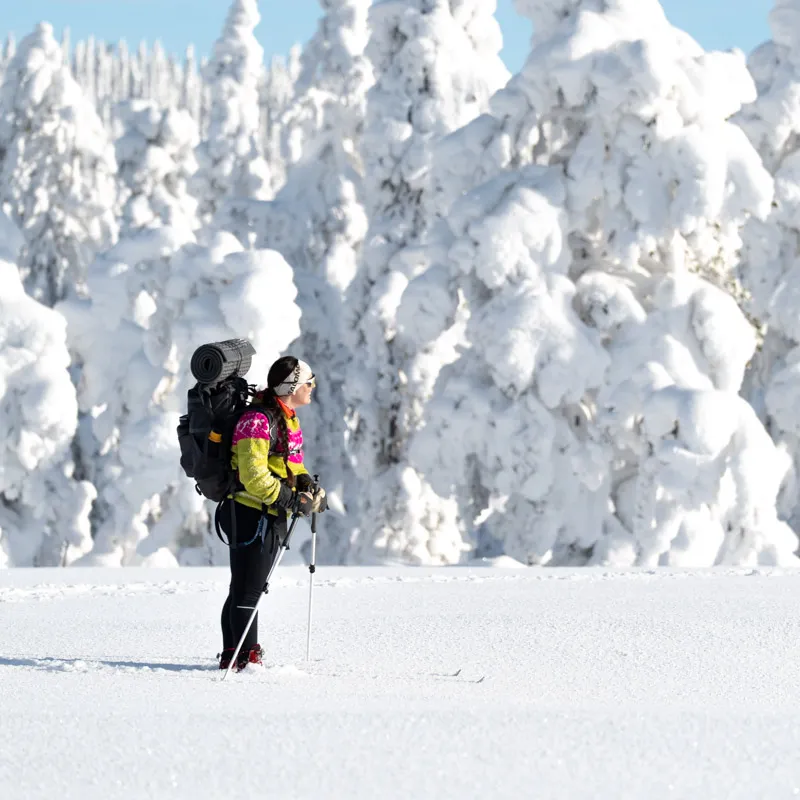
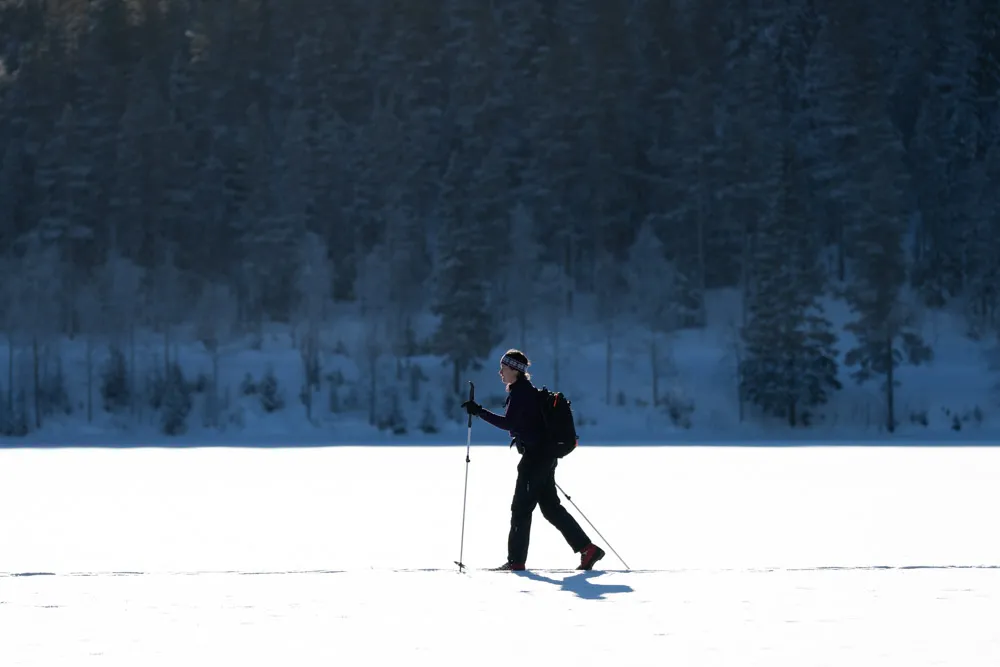
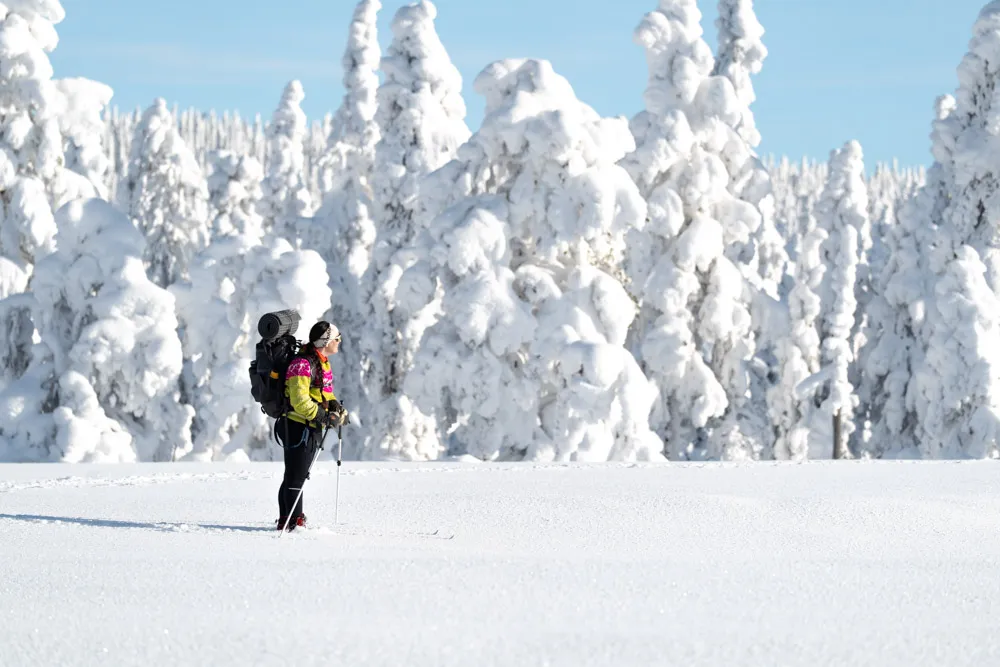
We tour on skis in nearby nature reserves, including the vast forests and frozen wetlands of Norra Mora Vildmark. This is true wilderness, where we make our own tracks across the snow. Old spruce and pine stand close before thinning into wide mires where the horizon stretches beneath the unbroken blanket of snow. The terrain is softly rolling rather than mountainous. We're stepping into a wild winter landscape – in a way that’s easy, unhurried, with a warm sauna waiting for us back at the cabin. One evening, that turns into something more – a proper sauna ritual. I’s a sensory experience shaped by the same elements as the day: cold, warmth, and stillness.
A different rhythm: fire and ice
At certain points throughout the week, the pace softens. A bit of a sleep-in. Then carving ice lanterns from blocks cut out of the lake, and trying your hand at ice fishing on the frozen water. A slower tempo right by the cabin — shaping ice with chisels and heated tools, and waiting quietly above the dark water below. Our catch, Arctic char or trout, is smoked over alder and spruce in a smokebox on the fire. We also roll and fire-bake “kavelgris”, a traditional local flatbread made here for generations.
Later that day, we wrap up our flatbreads and our catch, and ski from the cabin to a nearby lake where a tipi stands on the ice. We settle around the fire on sheepskins and enjoy a leisurely dinner before gliding back through the forest under headlamps and stars.
Quiet tradition or a climb with a view
Another day, a local guide joins us for several hours of traditional kurbits painting, learning the flowing organic forms and colours rooted in Dalarna’s heritage. The style is surprisingly approachable – even simple shapes and patterns quickly come together into something beautiful. We sit inside by wood-fired heaters and candlelight, focused and relaxed.
For those who feel drawn to spend more time outdoors instead, one of our guides leads a more demanding outing than our other ski days. We head to the remote heights of Anjosvarden–sometimes called Sweden’s southernmost alpine peak. In truth, it’s a fell, rising high enough to stand above the tree line. Our journey to the top includes some steeper inclines, but is mostly flat, crossing broad frozen mires. Along the way, we pass low, solitary trees completely covered in snow, "opplega", forming fantastical shapes and silhouettes. If the weather is clear, we get sweeping views of the Transtrand and Fulufjället mountains to the west.

Deposit: 1,000 SEK at the time of booking
A winter state of mind
This week is about living winter, rather than pushing through it. We stay in one place, with our warm cabin at the centre, heading out into the surrounding landscapes on touring skis. We also slow things down — with fire, food, sauna and simple rhythms that are just as much a part of the experience.


5 nights in off-grid cabin by Lake Navar
Ski touring in surrounding landscapes
Ice fishing, kurbits painting, sauna ritual
Learn from fun and experienced guides
Meals with local connection
Dates
24–29 January
7–12 March
All departures are guaranteed.
Transfer times
Pickup: 17:35 at Mora train stn
Dropoff: 12:00 at Mora train stn
Prerequisites
Age limit, 15 years
Fitness level, Low-Medium (able to hike in flat terrain)
No ski touring experience required.
Payment
1,000 SEK deposit per person at the time of booking, remaining balance due 6 weeks prior to your departure.
Cancellations
Full refund up until 6 weeks prior to your departure. 50% refund up until 3 weeks prior. No refund less than 3 weeks prior.
Accommodation
Shared twin or quad rooms in cabin.
Dietary requirements
Just let us know well in advance and we'll sort it out.
Useful Links
The Navar Valley sits in a remote part of Northern Dalarna — an expansive wilderness of deep boreal forest, heathland and fells. This is the part of Sweden we have in our minds eye, when thinking of a time long gone, where many of our traditions have their roots. It’s quiet and largely unknown outside our borders, with very few people. Just long stretches of landscape where winter is lived the way us Swedes like to live it.
Our cabin on the shores of Lake Navar is off-grid, surrounded by rising hills of tall spruce, lakes and rivers. We’re at semi-high altitude and skiing is wild, but gentle and unexposed.
Nearby, in the Norra Mora Vildmark nature reserve, the forest thins out into flat, open wetlands — an ideal place for easy skiing in a striking landscape. The terrain stays low and rolling, but the sense of space grows — long horizons and a feeling of being properly out there.
Ski touring is a beginner-friendly activity, especially in flat terrain. It's very similar to hiking, but on skis.
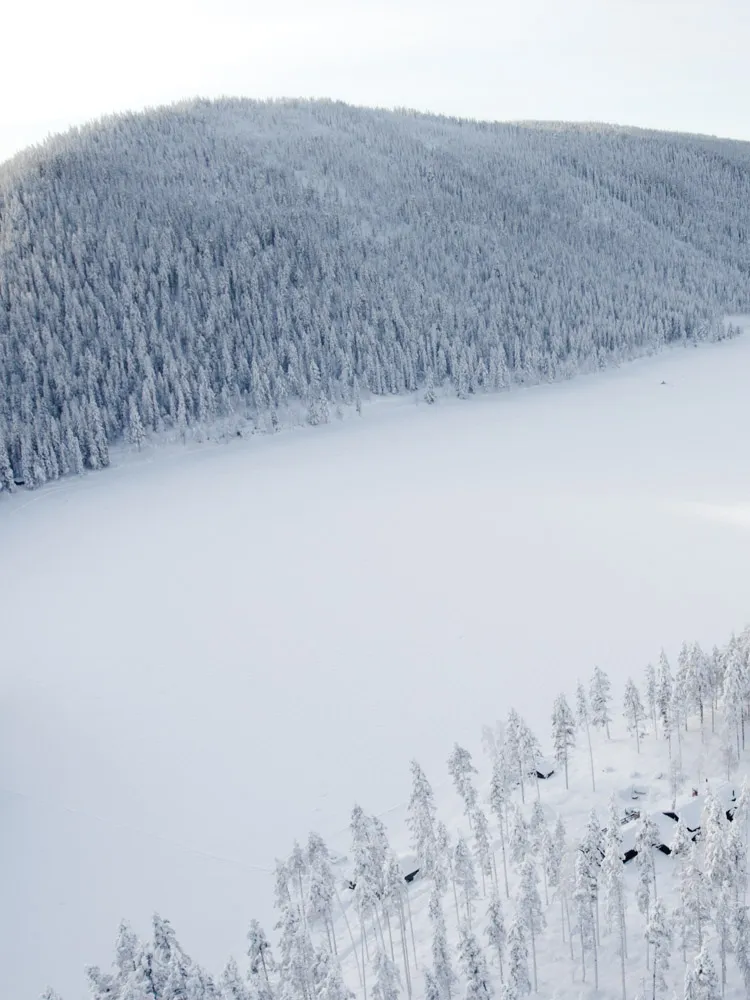
This is a really special place to us and everyone who stays here. Just as Lina from nearby Älvdalen intended when she made this old family forest hideaway into what it is today. The cabin becomes a seamless transition between the wilderness outside, and the warmth and cosiness indoors. Every item has a story – homeliness created with such thought and care.
There is a large dining and communal room, a kitchen that runs on gas and adjoining sleeping quarters with five rooms. Lake Navar stretches below and the sauna is right by the waterfront.
Simply arriving and settling into life here is an experience in itself. Candles and wood-fired stoves light and warm the rooms. Water is collected from the stream. Our “bathtub” is the sauna and ice plunge, or buckets of hot water if you don't feel like doing the plunge.
Guests who come on our winter camping tours often say they wish they had more time at the cabin. Life feels rustic, yet so comfortable and beautiful here.

We may throw around the order a bit to adapt to weather conditions, but the week may look something like this:
Day 1
Pick-up in Mora → 1.5 hr drive to Navar Valley
Settle into cabin life
Dinner + sauna
Day 2
Our first steps on touring skis in Norra Mora Vildmark
Easy pace, 5–6 km
Cook lunch in the snow
Dinner + sauna ritual (surprise what that entails)
Day 3
Slow day close to cabin
Ice carving + ice fishing
Flatbreads on muurikka, smoke our catch
Early evening ski (4 km) to tipi on a nearby lake
Dinner at the tipi
Ski back by headlight (slightly downhill)
Day 4
Deeper into a wilder part of Norra Mora Vildmark
Longer ski, 7–9 km
Cook lunch in the snow
Dinner + sauna
Day 5
Choose your pace:
– Kurbits painting with local guide
– Or ski to Anjosvarden peak (7–10 km, steeper terrain)
Final dinner + sauna
Day 6
Breakfast
Pack up
Drive to Mora (train just after noon)


All you need to know, and then some
We have gathered the most important guides for this trip. If you want to delve deeper, there is more to discover in Guides & Articles.


Frequently Asked Questions
The easiest way to reach Mora is by train. There are direct services from Stockholm, and the journey takes around four hours.
We meet the group at Mora train station at 17:35 on day 1. From there, we drive together to the cabin in the Navar Valley.
On the final day, we leave the cabin after breakfast and return to Mora train station at 12:00.
If you’re flying into Sweden, Stockholm Arlanda is usually the most convenient airport. From there, you can continue towards Mora by train, either the same day or after a night in Stockholm depending on your flight times.
Our pickup and drop-off times are specifically planned around the train arrivals and departures in Mora, so you don’t need to build in any extra margin.
The exact order can shift a little depending on weather and snow conditions, but a typical week looks something like this:
- Day 1: We meet you in Mora in the late afternoon and drive around one and a half hours to the Navar Valley. Once we arrive, there’s time to settle into the cabin, have dinner and get the sauna going.
- Day 2: Our first proper day on Nordic touring skis in Norra Mora Vildmark. We keep the pace easy, ski around 5–6 km and cook lunch out in the snow. In the evening, there’s dinner and our sauna ritual.
- Day 3: A slower day around the cabin, with ice carving and ice fishing on the lake. We make local flatbreads, smoke our catch, then head out for an early evening ski of around 4 km to a tipi on a nearby lake for dinner. Afterwards, we ski back through the forest by headlamp.
- Day 4: We head deeper into Norra Mora Vildmark for a longer ski of around 7–9 km, with lunch cooked outside before returning to the cabin for dinner and sauna.
- Day 5: You choose the pace. Either stay at the cabin for several hours of traditional kurbits painting with a local guide, or head out on the more demanding 7–10 km ski to Anjosvarden. In the evening, we come back together for our final dinner and sauna.
- Day 6: Breakfast, pack up and drive back to Mora for the train just after noon.
The idea is to mix longer days out with slower days around the cabin, so the week never feels like six straight days of skiing.
Yes. You don’t need any previous ski experience to join this trip.
We use Nordic touring skis, and the terrain around the Navar Valley is mostly gentle, with frozen lakes, mires, forest and low rolling hills rather than steep mountain slopes.
We start with the basics and give you plenty of time to get used to the skis before heading further out. The emphasis is very much on enjoying the winter landscape rather than covering big distances or mastering difficult technique.
You should be reasonably comfortable being active outdoors for a few hours at a time, but you don’t need to be an experienced skier or particularly sporty. It's all very unhurried.
Nordic touring skis are made for travelling across snow rather than following prepared tracks. They’re wider and more stable than regular cross-country skis, with metal edges for extra control.
Most of the time, it feels a lot like walking or hiking on skis. We move across frozen lakes, mires and through the forest at a steady pace, making our own tracks as we go.
The terrain on this trip is gentle, so there are no big uphill climbs or long, steep descents. There are a few small slopes and undulations, but nothing too technical. You don’t need any previous skiing experience.
If you decide to go for the Anjosvarden outing, there will be a bit more altitude differences, but by then you willl have had quite a bit of practise.
You don’t need to be super fit at all, but you should be comfortable being active outdoors for a few hours at a time.
Most of the skiing is over gentle terrain, and the distances are fairly modest. We take regular breaks, keep the pace relaxed and have plenty of time during the week.
If you’re happy going for a decent walk or hike and spending a good part of the day outside, you should be absolutely fine. The one exception is the Anjosvarden outing – it will be more challenging with some uphill and longer distances. But it's optional and you can stay cosy in the cabin painting kurbits instead.
The skiing is spread out across the week, with a mix of shorter and longer outings rather than big distances every day.
On our first full ski day, we usually cover around 5–6 km in Norra Mora Vildmark. The ski to the tipi dinner is shorter, at around 4 km, and the longer wilderness ski is usually around 7–9 km.
On day 5, if you choose the Anjosvarden option, that’s the longest and most demanding ski of the week at roughly 7–10 km. If you choose kurbits painting instead, there’s no ski outing that day.
The pace is relaxed throughout, with time for breaks, lunch outside and simply being in the landscape. We’re not trying to cover as much ground as possible.
Pretty much everything you need once we meet in Mora.
The trip includes transport between Mora and the Navar Valley, five nights at our off-grid cabin, all meals, guiding throughout the week and all the activities in the programme.
We provide the Nordic touring skis and other specialist winter equipment you’ll need for the activities, including the gear for ice fishing and ice carving.
The only things you need to arrange yourself are your journey to and from Mora, personal clothing and travel insurance.
That’s absolutely fine. We keep the pace relaxed, take plenty of breaks and give you time to get used to the skis as the week goes on.
Because we stay at the same cabin throughout the trip, there’s much more flexibility than on a point-to-point journey. For most activities we have two guides, which means the group can split if needed. One part of the group can carry on while another takes a shorter route, turns back earlier or spends more time closer to the cabin.
The terrain is generally gentle, with no big climbs or long steep descents. The aim is to enjoy being out in the winter landscape, not to push anyone beyond what feels manageable.
The exception is the Anjosvarden outing, where the group stays together with one guide. But that's an optional activity while the rest of the group spends time at the cabin painting kurbits.
No. The week is meant to have a relaxed pace, and you don’t have to join every activity if you’d rather sit one out.
Some days have natural choices built in already, like day 5, when you can either join the longer ski to Anjosvarden or stay at the cabin for kurbits painting.
And if you simply feel like taking a quieter day, that’s fine too. You can sit an activity out, curl up with a book in the cosy cabin or just enjoy a few slow hours by the fire.
We also have a cabin host who looks after things like keeping the fires going and making sure the cabin is warm and welcoming, so if you decide to skip an outing, you won’t be left completely on your own.
The same goes for things like the ice plunge. You’re very welcome to give everything a go, but there’s no pressure to do it unless you want to.
You’ll need your own personal winter clothing and the usual personal items for a week away. We provide the Nordic touring skis, a daypack, gloves and the specialist equipment used during the activities.
The most important thing is having a good layering system rather than one enormous jacket. You’ll want warm base layers, insulating mid-layers, a waterproof outer layer, a hat and warm winter footwear for around the cabin and outside when you’re not skiing.
For the sauna, bring swimwear and something easy to throw on afterwards, such as a robe or large towel. Crocs or similar can also be handy for the short walk between the cabin, sauna and lake.
We have a full winter clothing kit available to rent if you don’t already own suitable gear. Before the trip, we’ll also send you a detailed packing list so you know exactly what to bring.
We head out onto the frozen lake right by the cabin, drill through the ice and spend a couple of relaxed hours trying our luck for Arctic char or trout.
It’s a simple, traditional way of fishing and you don’t need any previous experience. We’ll show you how everything works and provide all the equipment. And the good news is that the odds are usually better than with more conventional fishing – you’re fishing through known spots on the lake, so there’s a decent chance of actually catching something.
If we do, we can bring it back and smoke it as part of thhe evening's food.
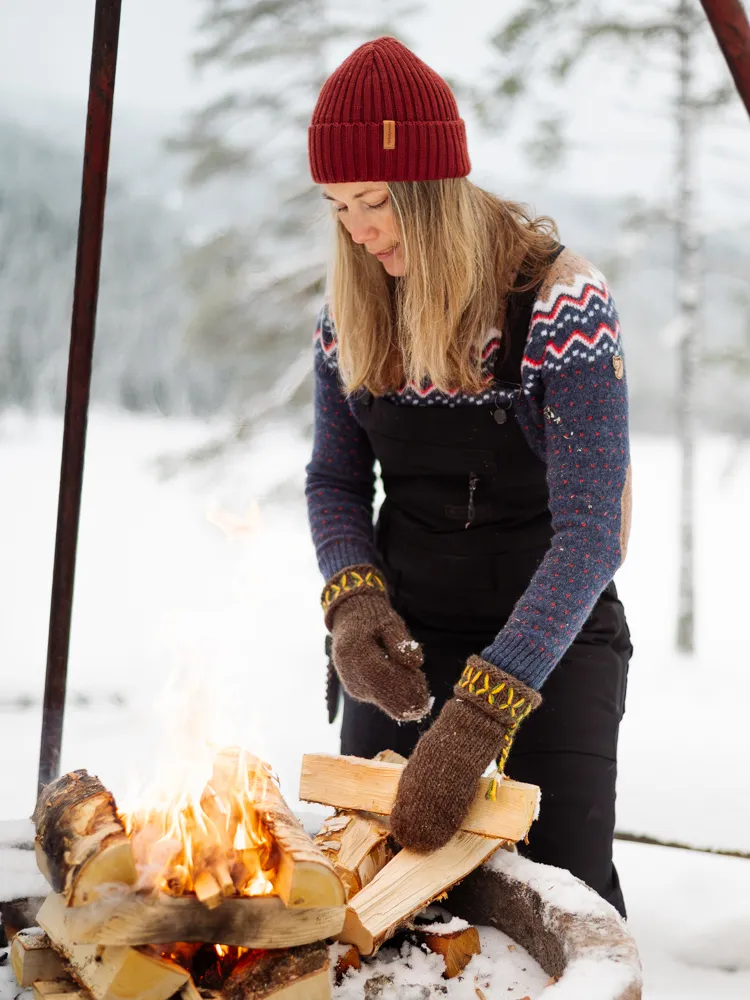
And if fishing isn’t really your thing, there’s plenty else going on. We keep a fire going outside by the cabin, where we make waffles for lunch and bake local flatbreads for dinner. And you can spend more time working on your ice carving.
It’s deliberately a slow, flexible day close to the cabin rather than an activity everyone has to do at the same time.
Yes. If you don’t already have suitable winter clothing, you can rent a full Houdini winter kit from us.
The kit includes the main shell and mid-layers you’ll need for the week, including a waterproof shell jacket and trousers, a warm fleece layer and an insulated jacket.
For particularly cold weather, you can also rent an extra Houdini Bouncer Jacket as an additional warm layer for stops and colder days.
We provide gloves as part of the trip, so you don’t need to buy specialist winter gear just for the week.
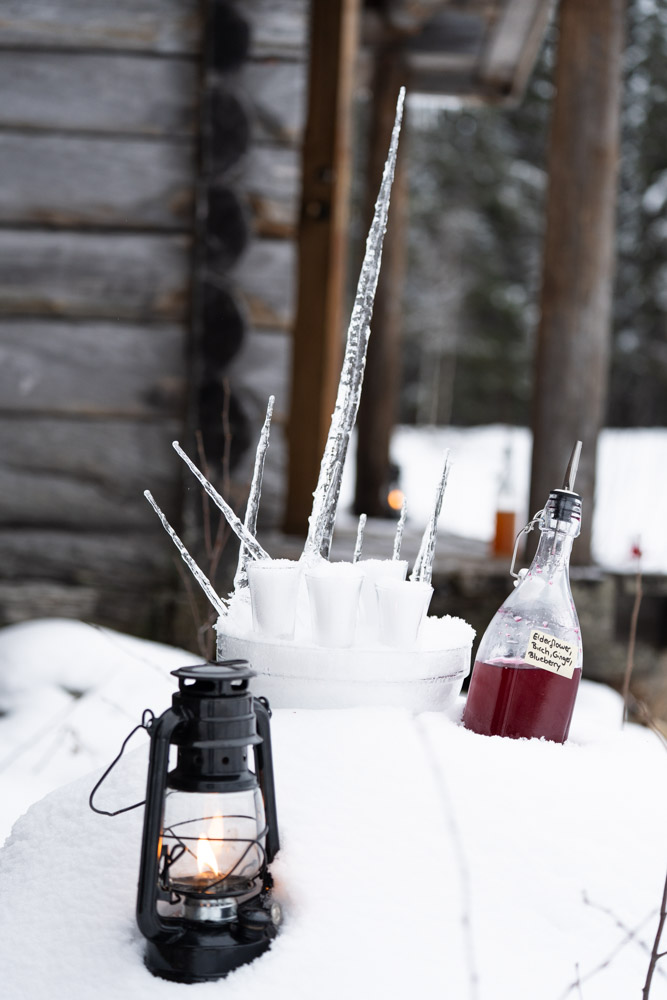
We cut large blocks of clear lake ice and turn them into sculptures using a mix of chiselling tools, heated tools and hot water.
You can keep it as simple or ambitious as you like. A particularly nice thing to make is an ice lantern, which we can light later in the evening.
It’s surprisingly absorbing once you get started, and because it takes place close to the cabin, you can dip in and out of it during the slower part of the day alongside the ice fishing and flatbread making.
Our base for the week is a remote off-grid cabin beside Lake Navar, surrounded by forest and low hills.
Inside, it’s all dark timber, old furniture, wood-burning stoves and candlelight. It’s rustic, warm and very cosy, and feels much more like part of the landscape than somewhere you’ve stepped away from it.
Two people share each room, and there’s a proper gas kitchen where we cook our meals together. There’s no running water, so life is a little more basic than at home, but that’s very much part of the experience.
The wood-fired sauna sits right by the lake and quickly becomes part of the daily routine. After a few hours out in the cold, getting properly warm before dinner is hard to beat.
We head out in the early evening and ski around 4 km through the forest to a tipi on a nearby lake.
Once we arrive, we settle onto sheepskins around the fire, get properly warm and spend a couple of hours there. We cook dinner together over the fire, eat slowly, have something hot to drink and let the evening stretch out before it’s time to head back.
By then, it’s fully dark outside. The ski home by headlamp is a big part of the experience. The beam lights just enough of the snow ahead, while the rest of the forest disappears into silhouettes and darkness.
The cabin is completely off-grid, so there’s no running water or mains electricity.
We collect fresh water locally and heat what we need for cooking and washing. Lighting comes from candles and lanterns, and the wood-burning stoves keep the cabin warm.
There’s no conventional shower. Instead, washing is part of the sauna routine: we heat water in the wood-fired sauna by the lake, where you can wash properly and warm up after a day outside. If you want to cool off between rounds, there’s an ice hole just outside.
The toilet is in a separate outhouse about 15 metres from the cabin.
It’s a simple setup, but after a day or two it quickly starts to feel very natural — and very much part of being out here.
Kurbits is a traditional style of decorative painting from Dalarna, built around fantastical, organic shapes that often grow out symmetrically from a central form. Think curling leaves, flowers, pods and imaginary plants, all flowing into one another in bold, decorative patterns.
A local guide comes to the cabin for a five-hour session and takes us through the basic techniques. One of the lovely things about kurbits is how much can be done with quite simple brushwork: you dip the brush into two colours at once and create shaded strokes in a single movement, then use the back of the brush to add small decorative dots and details.
You don’t need any previous painting experience, and it’s surprisingly easy to make something beautiful even if you don’t consider yourself artistic.
We spend the session indoors by the wood heater, with lanterns and candles lit around the cabin, working at a relaxed pace on your own piece to take home with you.
Food is a big part of the week! We put a lot of care into what we eat, with good breakfasts, lunches and dinners throughout the trip. Some meals are cooked in the cabin, while others are part of the activities themselves, like the tipi dinner or preparing something from the day’s ice fishing.
We use local ingredients and traditional flavours from Dalarna where it fits, and the food is very much part of the experience rather than just fuel for the day.
Yes, we can cater for most dietary requirements. Just let us know when you book so we can plan everything properly in advance.
This is the more demanding ski option of the week, at around 7–10 km, and takes us further from the cabin into more varied terrain.
We climb gradually through the forest towards Anjosvarden, with a few steeper sections along the way. At around 760 metres, the summit is bare and open, giving it a surprisingly fell-like feel. It’s often called Sweden’s southernmost fell, although technically it sits just below the natural tree line.
Once we reach the top, the landscape opens up completely. In clear weather, you can see Transtrandsfjällen and Fulufjället on the western horizon.
We bring lunch and hot drinks and spend several hours out before skiing back to the cabin. It’s the most adventurous ski of the week, and a great option if you’re feeling comfortable on the skis by day five and fancy something a little more challenging.
It can vary quite a bit, but typical temperatures during the winter season are:
- January: around -10°C to -20°C
- February: around -6°C to -15°C
- March: around -3°C to -10°C
You can still get warmer spells around freezing, as well as colder nights below those averages.
The cold also feels very different depending on what you’re doing. When we’re skiing, you’ll often be much warmer than you expect. You notice it most when we stop for lunch, spend time ice fishing or are standing around outside without moving much.
That’s why layering matters so much. We’ll help you adjust what you’re wearing throughout the day so you stay warm without getting sweaty.
The sauna becomes a big part of life at the cabin, but one evening we make a bit more of an event of it.
We heat the wood-fired sauna properly, light candles and lanterns, and take our time with a few rounds of heat and cooling off in between. If you’re feeling brave, that can mean a dip in the ice hole just outside, but there’s absolutely no pressure.
The ritual itself is designed to involve all your senses, but we keep the details as a surprise until the evening.
It’s a long, slow sauna session that leaves you thoroughly warm, very clean and deeply relaxed.
Both are proper winter, but they have quite a different feel.
January is the darker, colder part of the season. Expect deep snow, long blue twilight and around five to six hours of daylight. The low light gives the landscape an almost monochrome quality, and some of our skiing may be by headlamp as the afternoon fades. On clear nights, moonlight on the snow can make the whole valley surprisingly bright.
March brings longer days and generally milder temperatures. The sun sits higher, we have much more daylight to work with and the days often feel noticeably softer and brighter.
Neither is better than the other — January is about deep winter, blue light and darkness, while March gives you more sun and longer days.
The itinerary is mostly flexible, so we can move things around if the weather or snow conditions aren’t ideal for a particular activity.
Because we stay at the same cabin all week, we have plenty of options. We might swap the order of the ski days, spend more time on activities closer to the cabin, or move something indoors until conditions improve.
We keep a close eye on the forecast throughout the week and make the call based on what will give you the best and safest experience. Bad weather doesn’t usually mean losing a day – it just means doing things in a slightly different order.
Not at all. The ice hole is there if you want to try it, but it’s completely optional.
Plenty of people prefer to cool off more gently between sauna rounds, and we always have hot water available for washing off instead.
If you do decide to give the plunge a go, it’s only a few steps from the sauna, so you can be straight back in the heat afterwards.
Can't find an answer?
Send an email to Helena:
contact@dothenorth.com
Give us a call:
+46 (0) 707 13 96 09