The Cabin and Our Surroundings
Dalarna holds a special place in the hearts of many Swedes. It’s what we picture in our mind’s eye when thinking of old traditions and a way of life rooted in forests, lakes and small communities. In the remote northern part of the region lies the Navar Valley, where we’ve made a winter home at our cosy off-grid cabin by a frozen lake.
Where the Navar Valley is
The valley lies north-west of Mora, in a part of Dalarna with deep boreal forest, heathland, low fells and very few people. It’s quiet and largely unknown outside Sweden, which is a big part of why we like it.
Right next to the valley is Norra Mora Vildmark, a large nature reserve of old forest and open mires that freeze solid in winter. Further into the wilderness lies Anjosvarden, a fell rising some 760 metres above sea level, with open views across the surrounding forests and mountains.
Getting here is simpler than it sounds. The direct train from Stockholm to Mora takes about four hours. We pick you up at the station and drive for about an hour up the valley to the cabin. For trains and connections, see our guide Getting to Dalarna.
Our cabin by Lake Navar
Our off-grid cabin sits by the frozen shores of Lake Navar, surrounded by rolling hills of tall spruce forests for miles and miles. It’s wonderfully remote, blending quietly into the winter landscape around it.
Guests on our winter camping expeditions often tell us they wish they could have spent more time here. And that’s partly how Winter Week came about. A chance to spend the whole week at this special place, without having to pack up and move on.
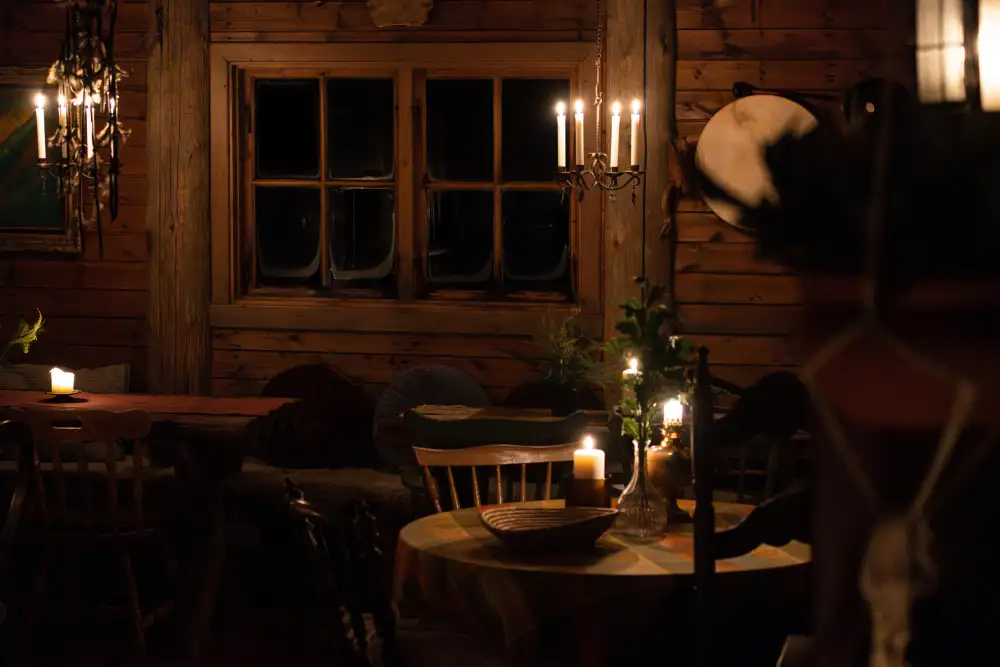
The cabin started out as an old family forest hideaway. Lina, from nearby Älvdalen, turned it into what it is today, filling the rooms with furniture, curious objects and little treasures collected over the years. Every corner seems to have something interesting to look at.
Life here is simple but wonderfully cosy. Wood-fired stoves keep the rooms warm, while lanterns, candles and the glow from the fires light up the evenings. Our cabin host keeps the fires burning and collects water from the stream while we’re out exploring. Often a previous guest who loved life at the cabin so much they decided to come back.
There’s a large dining and communal room, with adjoining sleeping quarters. We sleep in shared twin rooms, plus one four-bed room that we rarely fill to capacity. The outhouse is about 15 metres from the sleeping quarters.
And then there’s the sauna, right by the frozen lake. We heat it up every evening, and those feeling adventurous can take a dip through a hole in the ice. If that doesn’t appeal, there’s warm water in the sauna too.
Norra Mora Vildmark
Right by the Navar Valley lies Norra Mora Vildmark, a vast nature reserve where we’ve spent years exploring the forests and frozen wetlands. There’s always somewhere new to discover, even for us.
It’s a landscape of contrasts. Dense forests of enormous old spruce trees give way to open mires dotted with little islands of ancient pines. In winter, these wetlands freeze over and become enormous fields of snow, opening up routes that would be difficult or impossible to follow during the warmer months.
What we particularly love is how the scenery keeps changing as we travel through it. We might spend a while winding between tall trees, then suddenly emerge onto an open mire with open views. There are no prepared ski tracks, and very little evidence of other people ever having been there.
Despite the wild surroundings, the terrain is very forgiving. Most of it is flat or gently rolling, so we can enjoy exploring without having to deal with steep climbs or tricky descents. It’s a wonderful introduction to Nordic ski touring, but the landscape is just as rewarding for those of us who’ve been skiing for years.
Anjosvarden
For those who fancy a more demanding day on skis, we offer an optional outing to Anjosvarden, a remote fell in northern Dalarna.
At around 760 metres, the summit rises above the surrounding forests into a much more open landscape. Anjosvarden is sometimes called Sweden’s southernmost fell, although technically it sits just below the natural treeline.
Getting there involves a longer ski tour of around seven to ten kilometres, including some steeper sections. Much of the route crosses broad frozen mires, with the landscape becoming more open as we approach the higher ground.
One of the most unusual features of Anjosvarden is its opplega. These are small, solitary trees that become completely covered in snow, forming strange shapes and silhouettes. Some look like animals, others like trolls or figures standing out in the white landscape.
And if the weather is clear, there are sweeping views towards Transtrandsfjällen and Fulufjället to the west.
It’s a very different experience from our gentler days around Lake Navar and Norra Mora Vildmark. By this point in the week, everyone has had plenty of time to get used to their touring skis, so those wanting a bit more of a challenge can take the opportunity.
Those who’d rather stay at the cabin have something quite different to look forward to: an afternoon learning traditional kurbits painting with a local guide.
For a deep-dive into what we'll do during the trip, see our guide Ski Touring and Activities.
For more info on how to dress and what to pack, check out our guides Dressing for Winter Activities and We Provide & What to Bring.